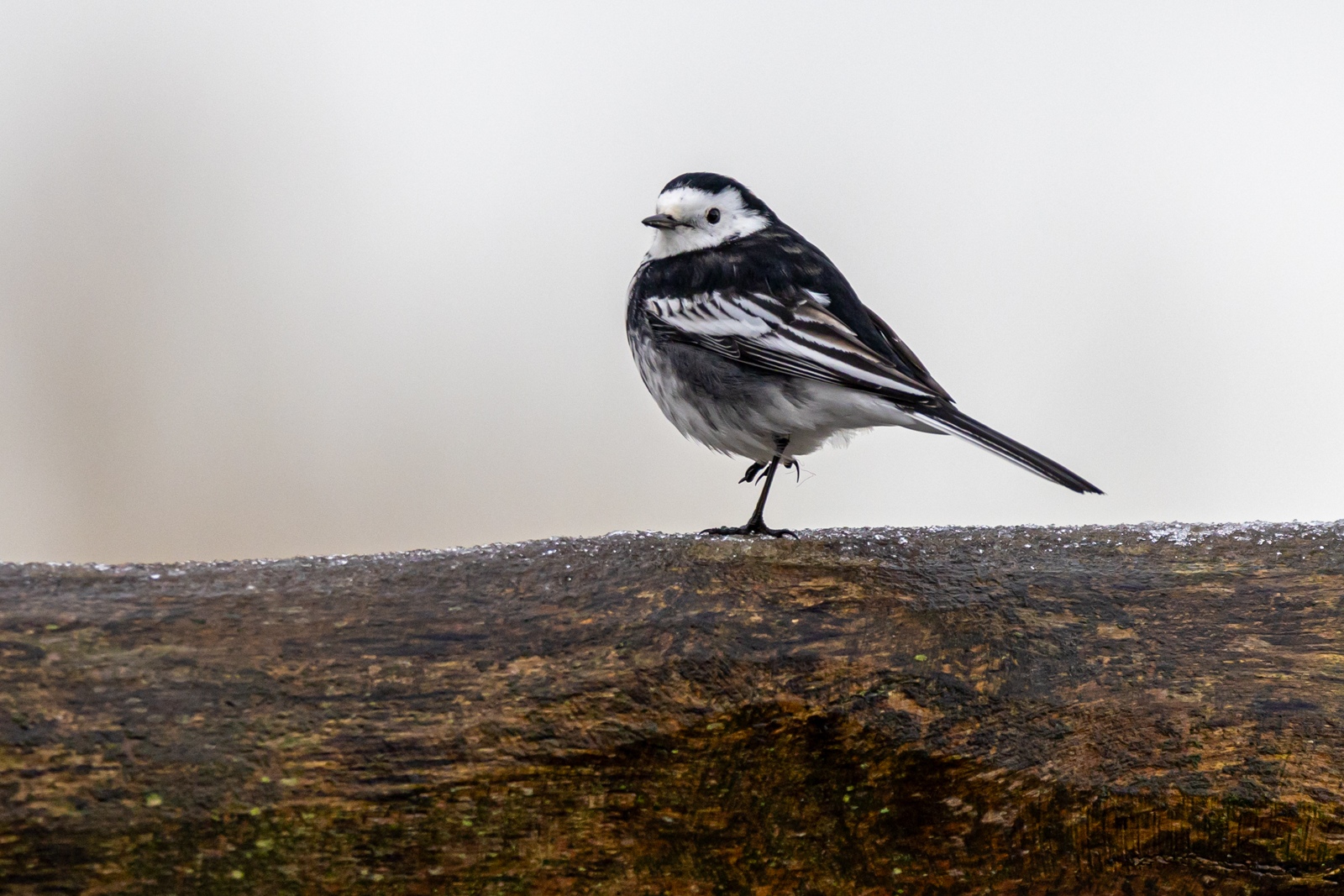
The Pied Wagtail (Motacilla alba yarrellii) is a distinctive black-and-white bird, easily recognized by its slender build and exceptionally long tail that it bobs incessantly. Adult males feature a jet-black crown, throat, and back, which contrast sharply with their white face and belly. Females are generally lighter, often possessing a dark grey back rather than solid black. Unlike other common wagtails in Northern Ireland, such as the Grey Wagtail, the Pied Wagtail lacks any yellow plumage on its underparts, appearing entirely monochromatic.
Known for its high energy, the Pied Wagtail typically walks with a characteristic jerking head movement or dashes rapidly across open ground to pursue insects. It is highly adaptable and frequently seen in urban settings like car parks and rooftops, where it scavenges for food or catches flies mid-air. In winter, these birds exhibit a fascinating social habit of forming large communal roosts, sometimes numbering in the hundreds, in city-centre trees or on warm buildings to conserve heat during the night. Their flight is noticeably undulating, often accompanied by a sharp, two-note “chis-ick” or “schizzick” call.
Nesting habits of the Pied Wagtail are remarkably versatile, as they often utilize man-made structures alongside natural sites. They commonly tuck their cup-shaped nests into crevices in stone walls, under roof tiles, or even within abandoned machinery. The female primarily constructs the nest using moss, grass, and twigs, lining it with hair or feathers for insulation. In Northern Ireland, breeding usually begins in mid-April, with pairs often raising two or sometimes three broods in a single season.
In Northern Ireland, the Pied Wagtail is a widespread and common resident found in almost every habitat, from rugged coastal regions to inland farmyards and busy town centres. While they are present year-round, population densities are particularly high across Ireland compared to some upland regions of Great Britain. Visitors to local landmarks like Belfast City Hall or rural sites managed by the Ulster Wildlife Trust can frequently spot them patrolling open spaces. During the 2026 winter months, they remain visible throughout the province, though some may move from exposed high ground to more sheltered lowland or urban areas.